As mentioned in an earlier blog The Guardian published Ruth’s recipe for Limoncello, Lemon and Blueberry Cloud Cake – in the under 500 calories, a definite low-cal original was in the running for the first prize but pipped to the post why?
Felicity Cloak says ‘Ruth Joseph’s light as air cake lost out on the winning spot this week as I ate a quarter in one sitting completely defeating the purpose so I’ve gone for another person’s entry.'
Here's the recipe
Limoncello, lemon and blueberry cloud-cake
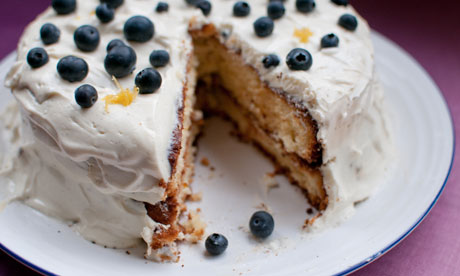
I have always had a passion for creating cakes that taste naughty without the guilt factor. This one is based on a plava recipe from my late mother. It's still deliciously moist and lemony, with a creamy luscious filling, laden with summer fruit, but not as naughty as its rich cousins – just really, really nice! Serves 10 at 330kcal per generous slice
For the cake6 eggs
150g caster sugar
A dessertspoon of vanilla sugar
Grated zest and juice of 1 lemon
Grated zest of ½ orange
75g plain flour
70g ground almonds
Zest of 1 lemon
100g caster sugar
2 tbsp limoncello (optional)
For the icing
500g low-fat Greek yoghurt
450g low-fat custard
3 tbsp icing sugar
Juice of ½ lemon
1 punnet of blueberries/summer fruit
1 Line 2 x 20cm sandwich tins with baking parchment and preheat the oven to 170C/325F/gas mark 3.
2 Separate the eggs. Put yolks in a large mixing bowl with the sugars and zests and beat until thick and creamy.
3 In a separate bowl, whisk the egg whites until stiff peaks form. Sift the flour and almonds twice, then fold into the egg-yolk mixture, along with the lemon juice. Carefully fold in the egg whites, pour into tins and bake for 30‑40 minutes. Allow to cool.
4 Meanwhile, use a peeler to cut strips of zest from the lemon, and slice into fine shreds. Put in a small pan with the sugar and 6 tbsp water and simmer until shreds are tender and the liquid syrupy. Add limoncello if using and simmer for a few more minutes. Cool, then use a tea strainer or similar to separate the shreds.
5 Combine the yoghurt and custard in a bowl. Add icing sugar and lemon juice to taste.
6 Pour half the syrup on to one of the cakes, then top with a third of the icing. Put the other cake on top and pour the remaining syrup over it. When it has been absorbed, spread the icing over the entire cake, and then decorate with blueberries and zest.
As promised the Buzz Feed Bagel feature and recipe.
"The essential part is not to rush it," says Ruth Joseph about making bagels. "Enjoy the feel of the dough and watching as they rise in the boiling water." The sixtysomething novelist, cookbook writer, and former pastry chef lives with her family in Cardiff, Wales, where, unsurprisingly, the bagel offerings are not excellent. "They are, shall I say, plastic," she says, describing a tragedy that many middle-American bagel lovers can relate to. Joseph, a trained nutritionist, wasn't thrilled with the additives of store-bought bagels, either. So she and her daughter set out to develop their own recipe.
It took some practice: "The first lot had virtually no holes as they rose into giant circular lumps." Now she's got it down, and bagels are one of 150 recipes in her new cookbook, Jewish Traditional Cooking. "The bagels also make lovely presents — especially with a pot of homemade cream cheese."
Homemade Bagels
These are better when made over two days.
Makes 40
INGREDIENTS
7 cups organic bread flour
2 cups organic self-rising whole-wheat flour
4 tsp. active dry yeast
1½ Tbsp. light brown sugar
2½ tsp. salt
2 Tbsp. light olive oil
For the cooking liquid:
1 Tbsp. molasses
1 Tbsp. baking powder
1 organic free-range egg, beaten, to glaze
Poppy, onion, or sesame seeds, for the topping
Variation with rye and caraway:
Substitute 7 cups organic bread flour and 2 cups rye flour for the other flours. For the topping, use 4 Tbsp. caraway seeds.

PREPARATION
1. In a medium bowl, combine 1½ cups of the flour with 3 cups lukewarm water, yeast, and sugar, and whisk until smooth. Make sure all the active dry yeast has dissolved.

2. Set aside in a warm place for about 10–15 minutes to ferment.
3. Meanwhile, combine the remaining 5½ cups flour with the salt in the bowl of your mixer.


4. Pour the oil into the fermented yeast mixture and beat with a fork until smooth.

5. With the mixer running, add the yeast mixture to the flour and mix to a soft, pliable dough.

6. Turn out onto a floured work surface and knead for 5 minutes until smooth. Oil a large bowl and place the dough inside.


7. Cover the top with oiled plastic wrap or a cloth, and set aside to rise in the fridge overnight.

8. The following day, divide the dough into 40 pieces and shape into balls.


9. Roll each ball of dough into a sausage shape and form into bagels by overlapping the ends to form a ring.

10. Allow a disproportionately large hole in the center so there is space for the bagels to rise (otherwise the holes will close).


11. Transfer the bagels to two or three baking sheets, lined with parchment paper and dusted with flour.

12. Cover with a clean cloth and leave to rise in a warm place for 20 minutes until doubled in size.
13. Preheat the oven to 425°F. Bring a large, wide pan of water to a boil. Add the molasses, and whisk in the baking powder.


14. You will need to cook the bagels in batches. Carefully drop the bagels — three at a time — into the boiling water.

15. Simmer for 2–3 minutes then quickly flip them over and cook them for another 2–3 minutes on the other side.


16. Remove them with a slotted spoon and put them back on the parchment paper while you cook the rest.

17. Once the bagels are cooked, glaze them with the beaten egg and sprinkle them with seeds.


18. Bake in the preheated oven for 10–15 minutes until golden brown— and be proud!


Recipe courtesy of Ruth Joseph and Simon Round's new cookbook, Jewish Traditional Cooking (Kyle Books, 2013).
Buzz Feed also published
From Jewish Traditional Cooking by Ruth Joseph & Simon Round
This delicious quiche-style "pie" (which is made without pastry) has evolved in the Middle East as a wonderful meatless meal.
SERVES 6-8 AS A MAIN COURSE
INGREDIENTS
4–5 leeks, sliced and washed really well
2 large onions, peeled and sliced
1 tablespoon olive oil
½ cup fresh chives, finely chopped
½ cup fresh flat-leaf parsley or coriander, finely chopped
1 vegetable bouillon cube
6 organic free-range eggs, plus 6 organic free-range egg yolks
½ cup milk
½ cup frozen peas
Salt and freshly ground black pepper
1 cup grated cheese of your choice
PREPARATION
Preheat the oven to 350°F. In a large frying pan, gently sweat the leeks and onions in the olive oil until soft but not colored. When they are tender and sweet, add the herbs and crumble in the bouillon cube. (If you wish, you can put the mixture in a food processor at this stage for a smooth texture.) Mix the eggs, egg yolks, milk, and peas together in a mixing bowl. Pour over the vegetable mixture and season to taste.
Pour into a deep 2-quart decorative baking dish and sprinkle with the cheese. Bake in the oven for about 40 minutes until golden and set.
Variation
Add 4–5 sliced, cooked portabello mushrooms to the mixture, or substitute 8 oz. blanched asparagus, cut into 2-inch pieces, for the peas.
Non-dairy alternative
Substitute coconut milk for the cows' milk and omit the cheese topping.
Leite's Culinaria featured the bagels too.
Have a look at what their testers said.
Every nation has its knish or equivalent — the Brits or Cornish love a pasty, the Spanish, empanadas while the Chinese go wild for a wonton. Sephardi Jews plump for a bureka but for Ashkenazi folk, it’s the knish.
While the knish — which also means “a small person” in Ukrainian — is definitely not common here, those who have spent time in the US will be more than familiar with this dumpling/pasty hybrid.
The snack started its life in the 14th century around the time the Jews were making their way from France — from where they had been expelled — to the Ukraine. At that stage it was a cabbage and meat dumpling wrapped in floury dough.
When potatoes became a common food as a result of a law by Catherine 1st who decreed that Jews plant potatoes alongside their grains, potatoes became both pastry and filling combined with fried onions, liver, buckwheat kasha, leeks, mushrooms and the ubiquitous cabbage.
In common with many dishes, the exact recipe differed across Eastern Europe. In Poland piroshki (as they were known) were offered as boiled, baked or fried dainties with similar fillings while the knishes’ cousin, kreplach, originated through the needs of superstitious European Jews.
At Rosh Hashanah they filled baked dough amulets with their New Year wishes suspended around their necks to wear during Yom Kippur, and eventually these amulets found their way into our soup.
When the Jews arrived in America in the late 19th century, Romanian immigrant Yonah Shimmel began selling golden, flaky knishes from a small pushcart, before opening a bakery in 1910.
The Knishery, as he called it, remains today on Houston Street in the Lower East side of New York. Shimmel’s renowned knish’s size has inflated to a large cricket ball-sized squashed bun, in contrast to its previous dainty Romanian equivalent
 Yonah Schimmel's Bakery in New York
And why am I so obsessed with the knish? Is it that melting flaky dough or the childhood wonderment of the secret inside: the hidden filling, which still thrills me? I was born from careful parents who considered every leftover as an ingredient for another meal — like the Jewish joke we never saw the original food. And in the beginning, when my mother made dishes from her past, we had knishes — made either of a flaky type of pastry almost a strudel dough, or if she was feeling energetic, puffy pillows of melting yeasty pastry but always delicate in our home.
Yonah Schimmel's Bakery in New York
And why am I so obsessed with the knish? Is it that melting flaky dough or the childhood wonderment of the secret inside: the hidden filling, which still thrills me? I was born from careful parents who considered every leftover as an ingredient for another meal — like the Jewish joke we never saw the original food. And in the beginning, when my mother made dishes from her past, we had knishes — made either of a flaky type of pastry almost a strudel dough, or if she was feeling energetic, puffy pillows of melting yeasty pastry but always delicate in our home.
And as for the fillings — my mother would always start with fried onions, sometimes fried in schmaltz, then added mashed potatoes and often the meat from the soup mixed with minced wurst. Or she would make a veggie option using soft cream cheese with chopped bright green spinach blended with fried onions and a spring onion finely chopped — the perfect any-time snack.
It is well worth taking the time to make these tempting Jewish heirlooms. Do give yourself a day to do it. Make the dough and filling in the morning, leaving the filling to cool. Then fill and bake it in the afternoon or even better, the next day when the flavour will have improved.
Purists demand a specific shape made by forming the dough into a rectangle, loosely filling it with the mixture and rolling it into a Swiss-roll shape. Then, like a sausage maker, the dough is given a twist every couple of centimetres or so. By cutting the twists, the little knishes are then set onto those cuts and the upper most twist is then poked in to form a pleated top.
Or for an easier method, cut small circles of dough and half fill them with your chosen filling before folding over one side and pressing down the edges to form a half moon. It does not matter as the flavour will sing whatever the shape.
True nostalgic Jewish food has never been elegant. It will never be nouvelle cuisine-style morsels tweezer-decorated with flowers and micro-herbs. It is generous food created by matriarchs — balabostas needing to fill hungry bellies with restricted resources.
My knishes pay homage to their genius in making the mundane taste fabulous.
Ruth Joseph is the co-author with Simon Round of Warm Bagels and Apple Strudel, Kyle Books, £25
For the final schmooze and more culinary adventures look at Ruth Joseph in The Foodie Bugle.
http://thefoodiebugle.com/author/252

Buzz Feed also published
A Meatless Main Course For Your Passover Seder
This leek and pea pie is filling and fresh, and can be made dairy-free if you miss the cheesy topping
Emily Fleischaker

Image by Isobel Wield
Leek and Pea Pie
From Jewish Traditional Cooking by Ruth Joseph & Simon Round
This delicious quiche-style "pie" (which is made without pastry) has evolved in the Middle East as a wonderful meatless meal.
SERVES 6-8 AS A MAIN COURSE
INGREDIENTS
4–5 leeks, sliced and washed really well
2 large onions, peeled and sliced
1 tablespoon olive oil
½ cup fresh chives, finely chopped
½ cup fresh flat-leaf parsley or coriander, finely chopped
1 vegetable bouillon cube
6 organic free-range eggs, plus 6 organic free-range egg yolks
½ cup milk
½ cup frozen peas
Salt and freshly ground black pepper
1 cup grated cheese of your choice
PREPARATION
Preheat the oven to 350°F. In a large frying pan, gently sweat the leeks and onions in the olive oil until soft but not colored. When they are tender and sweet, add the herbs and crumble in the bouillon cube. (If you wish, you can put the mixture in a food processor at this stage for a smooth texture.) Mix the eggs, egg yolks, milk, and peas together in a mixing bowl. Pour over the vegetable mixture and season to taste.
Pour into a deep 2-quart decorative baking dish and sprinkle with the cheese. Bake in the oven for about 40 minutes until golden and set.
Variation
Add 4–5 sliced, cooked portabello mushrooms to the mixture, or substitute 8 oz. blanched asparagus, cut into 2-inch pieces, for the peas.
Non-dairy alternative
Substitute coconut milk for the cows' milk and omit the cheese topping.
Leite's Culinaria featured the bagels too.
Have a look at what their testers said.
This weekend the The Jewish Chronicle featured Everything you could wish to know about the knish
By Ruth Joseph, April 11, 2013

Potato and Spinach Knishes. Photo: Isobel Wield
Now that chametz is back on the menu my thoughts return to one of my favourite treats — the knish. Every nation has its knish or equivalent — the Brits or Cornish love a pasty, the Spanish, empanadas while the Chinese go wild for a wonton. Sephardi Jews plump for a bureka but for Ashkenazi folk, it’s the knish.
While the knish — which also means “a small person” in Ukrainian — is definitely not common here, those who have spent time in the US will be more than familiar with this dumpling/pasty hybrid.
The snack started its life in the 14th century around the time the Jews were making their way from France — from where they had been expelled — to the Ukraine. At that stage it was a cabbage and meat dumpling wrapped in floury dough.
When potatoes became a common food as a result of a law by Catherine 1st who decreed that Jews plant potatoes alongside their grains, potatoes became both pastry and filling combined with fried onions, liver, buckwheat kasha, leeks, mushrooms and the ubiquitous cabbage.
In common with many dishes, the exact recipe differed across Eastern Europe. In Poland piroshki (as they were known) were offered as boiled, baked or fried dainties with similar fillings while the knishes’ cousin, kreplach, originated through the needs of superstitious European Jews.
At Rosh Hashanah they filled baked dough amulets with their New Year wishes suspended around their necks to wear during Yom Kippur, and eventually these amulets found their way into our soup.
When the Jews arrived in America in the late 19th century, Romanian immigrant Yonah Shimmel began selling golden, flaky knishes from a small pushcart, before opening a bakery in 1910.
The Knishery, as he called it, remains today on Houston Street in the Lower East side of New York. Shimmel’s renowned knish’s size has inflated to a large cricket ball-sized squashed bun, in contrast to its previous dainty Romanian equivalent
Yonah Schimmel's Bakery in New YorkAnd as for the fillings — my mother would always start with fried onions, sometimes fried in schmaltz, then added mashed potatoes and often the meat from the soup mixed with minced wurst. Or she would make a veggie option using soft cream cheese with chopped bright green spinach blended with fried onions and a spring onion finely chopped — the perfect any-time snack.
It is well worth taking the time to make these tempting Jewish heirlooms. Do give yourself a day to do it. Make the dough and filling in the morning, leaving the filling to cool. Then fill and bake it in the afternoon or even better, the next day when the flavour will have improved.
Purists demand a specific shape made by forming the dough into a rectangle, loosely filling it with the mixture and rolling it into a Swiss-roll shape. Then, like a sausage maker, the dough is given a twist every couple of centimetres or so. By cutting the twists, the little knishes are then set onto those cuts and the upper most twist is then poked in to form a pleated top.
Or for an easier method, cut small circles of dough and half fill them with your chosen filling before folding over one side and pressing down the edges to form a half moon. It does not matter as the flavour will sing whatever the shape.
True nostalgic Jewish food has never been elegant. It will never be nouvelle cuisine-style morsels tweezer-decorated with flowers and micro-herbs. It is generous food created by matriarchs — balabostas needing to fill hungry bellies with restricted resources.
My knishes pay homage to their genius in making the mundane taste fabulous.
Ruth Joseph is the co-author with Simon Round of Warm Bagels and Apple Strudel, Kyle Books, £25
For the final schmooze and more culinary adventures look at Ruth Joseph in The Foodie Bugle.
http://thefoodiebugle.com/author/252


